
From Salt to Sanctuary: Rethinking Conservation in Working Landscapes
What looks like abandoned infrastructure along the Tamil Nadu coast is, in fact, a vital refuge for migratory birds. The revival of the Kanyakumari salt pans reveals how care, governance, and stewardship can unlock conservation value in places long overlooked, and why such landscapes are essential to meeting global conservation targets..
JANUARY 2026
READING TIME: 10 MINS
At first glance, the salt pans of southern Tamil Nadu look like landscapes forgotten. Once shaped for salt production, some of these pans along the coast of Kanyakumari district have fallen into neglect. However, every winter, something extraordinary happens. Thousands of birds arrive; arctic-breeding shorebirds, long-distance terns, flamingos, ducks, and resident waterbirds descend on these working landscapes – resting, feeding, and refuelling after journeys that span continents and flyways. What appears abandoned at first glance reveals itself as critical habitat.


Working Landscapes As Wildlife Refuges.
Between 2021 and 2024, the Bombay Natural History Society (BNHS), supported by us at C-SCAPES* (a Tata Chemicals Ltd. initiative managed by TCSRD, Tata Chemicals Society for Rural Development), worked across a network of active and abandoned salt pans in Kanyakumari to test a simple but powerful idea: could neglected salt pans be managed deliberately as wetland habitat for migratory and resident waterbirds?
What followed was not “restoration” in the classical sense of returning land to a pre-human state, but a systems-oriented approach to stewardship, one that recognised these salt pans as working landscapes with ecological, social, and economic value. Water levels and salt concentrations were adjusted and carefully monitored and managed across seasons to create a mosaic of depths and salinity suited to different bird species. Bunds were repeatedly repaired, strengthened, and maintained, often in response to monsoon damage and breaches, to stabilise water retention and protect habitat integrity. Artificial roosts and large earthen mounds were constructed through sustained field effort to provide safe resting and nesting spaces during floods and periods of extreme weather. A key element was managing prey density by introducing laboratory-cultured brine shrimp to help meet the food requirements of both migratory and resident waterbirds.
The ecological response was striking.

Monitoring revealed dramatic increases in both abundance and diversity of migratory waterbirds using the salt pans. Thousands of terns were recorded during peak migration, including Common, Lesser Crested, Greater Crested, and Whiskered terns – several of them occurring in numbers exceeding the 1% global population thresholds used to identify sites of international importance. Shorebirds such as Little Stint, Curlew Sandpiper, Common Redshank, Marsh Sandpiper, and Grey Plover showed marked increases, with some freshwater-preferring species recording multi-fold rises compared to historical observations. The project has firmly established these salt pans as nationally and globally significant wintering and stopover sites (ecologically connected to wetlands spanning 14°–77°E and extending beyond 52°N). A ringed Whiskered Tern from the project site was spotted at the Nal Sarovar Bird Sanctuary in Gujarat, where it breeds. Similarly, the remarkable recovery in the UK (United Kingdom) of a Curlew Sandpiper, ringed at the our salt pans, demonstrates the linkages to global migration pathways.
Resident species responded to management efforts just as strongly: thousands of Spot-billed Ducks, Eurasian Coots, and Glossy Ibises were documented – numbers unprecedented for the district. Ringing studies deepened this picture further, revealing exceptionally high site fidelity, with some species showing return rates of up to 40%, and individuals repeatedly returning year after year. Birds captured at the salt pans were consistently heavier than conspecifics at other well-known sites, suggesting high prey availability and habitat quality.
Together, these patterns confirmed what simple counts alone could not: these salt pans were no longer marginal stopovers, but high-functioning wetlands embedded within a working coastal landscape.
Through my research, I recognised the importance of salt pans as alternative foraging and resting habitats for birds, particularly when natural coastal ecosystems are flooded during heavy monsoons or dry out in deficit years. This understanding was further reinforced through the TCSRD-supported C-SCAPES initiative to restore abandoned, brackish-water-fed salt pans in Kanyakumari District, which are rich in microflora and microfauna. The restoration project, currently being implemented by MBMT, was initially conceptualised as a research effort and later expanded into a multi-faceted conservation programme by Nisha DSouza and Vivek Talwar from the C-SCAPES team. Today, the initiative demonstrates how abandoned salt pans can function as vital refuges for both migratory and resident waterbirds while also drawing researchers and birders at a time when traditional coastal bird habitats are increasingly under pressure.
Dr. S. Balachandran
Principal Investigator & Managing Trustee, Migratory Bird Management Trust (MBMT)
(Advisor & Former Senior Scientist, BNHS)


From Restoration to Stewardship.
Building on this foundation, the second phase of the work, from 2024 onwards, led by the Migratory Bird Monitoring Trust (MBMT), with continued support from C-SCAPES, shifted focus from proving ecological value to sustaining it.
The emphasis expanded to year-round habitat management across approximately 45 hectares of salt pans, continued bird monitoring and ringing, and deeper engagement with governance questions: who manages these wetlands, for whom, and for how long?
As such, the work has extended well beyond birds and management of ecological factors. Salt pan lessees are compensated to offset partial production losses, fishermen are supported with gear and alternative fishing arrangements, and residents are engaged in restoration, maintenance, and monitoring activities. Students from nearby schools and colleges are brought into the landscape through field-based learning, while local youth are trained and mentored as bird guides and field assistants – building skills, confidence, and new livelihood pathways rooted in stewardship.

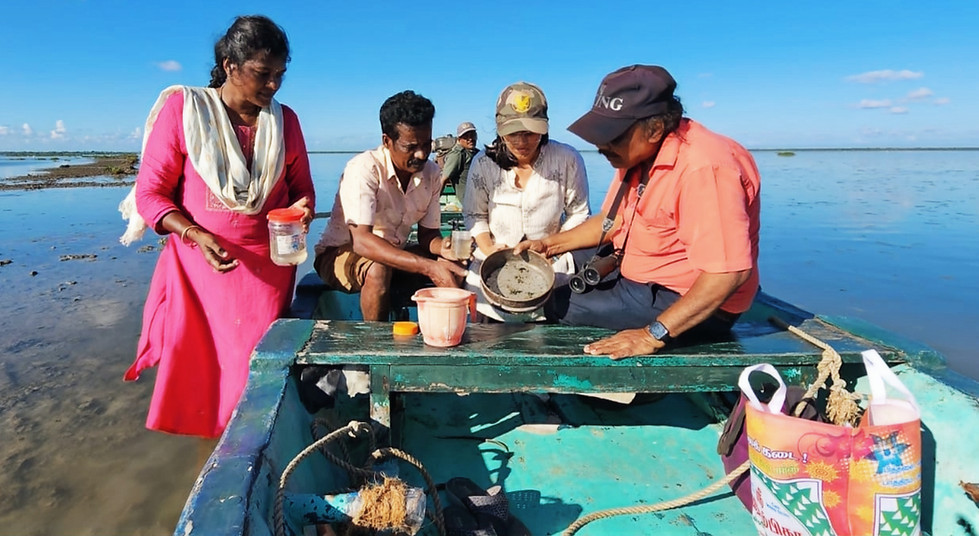
This second phase has coincided with new pressures, proposed industrial development nearby, climate variability affecting freshwater availability, and increasing tourism interest, making the question of long-term protection more urgent. Efforts are now underway to explore formal recognition of the salt pans under community-led governance and biodiversity frameworks, while retaining their identity as working landscapes.
Nonetheless, the salt pans continue to function as shared socio-ecological landscapes: places of work, learning, conservation, and community pride, sustained through everyday care rather than formal protection alone.
This work has been as much about systems as it has been about species. Supporting partners like MBMT has involved helping translate site-level ecological success into longer-term questions of governance, financing, and recognition, particularly around how working landscapes can be sustained beyond individual project cycles. This role sits less in implementation, and more in holding the connective tissue between science, communities, funders, and policy frameworks such as Other Effective Area-Based Conservation Measures (OECMs).


What This Means for 30x30 & OECMS
Globally, the world is far off track to meet the “30 by 30” biodiversity target. 30x30 refers to the global conservation goal to protect 30% of Earth's land and seas by the year 2030, a key target of the UN's Kunming-Montreal Global Biodiversity Framework to halt biodiversity loss and combat climate change.
Less than 10% of the ocean and only 17.6% of land and inland waters are currently under some form of protection. Expanding protected areas alone will not close this gap, especially in densely populated, human-modified landscapes like India’s coasts. This is where Other Effective Area-Based Conservation Measures (OECMs) matter. OECMs recognise that conservation does not only happen inside protected areas. It happens in places like salt pans, landscapes governed and managed for purposes other than conservation, yet delivering sustained and demonstrable biodiversity outcomes.
The salt pans were never designated wildlife habitats. They were industrial, leased, working systems. And yet, through intentional management, community engagement, and long-term monitoring, they now support globally significant bird populations, contribute to coastal resilience, and sustain livelihoods. In other words, they already function as OECMs – whether we formally recognise them as such or not.


Why This Story Matters.
The transformation of Kanyakumari’s salt pans challenges a deeply held conservation assumption: that nature must be fenced off to be protected. Instead, it offers a quieter, more realistic lesson, that biodiversity can persist, even thrive, in human-shaped landscapes when we choose stewardship over abandonment, and care over over-extraction. If the world is serious about achieving 30 by 30, it must learn to see value where it has long looked away. Sometimes, the wetlands we need are already there, waiting to be noticed.
For EcoNiche, stories like Kanyakumari’s salt pans reaffirm a core belief: that lasting conservation outcomes emerge when strategy, systems, and on-ground practice evolve together. Initiatives like C-SCAPES are not about owning projects, but creating the conditions in which diverse partners can collectively deliver impact, across landscapes, institutions, and time.
Photos by BNHS, MBMT and C-SCAPES.
*Nisha DSouza (Consultant, EcoNiche) supports the C-SCAPES initiative in a project coordination role.